Chapter I · CMU Master of Advanced Architectural Design · Thesis / Capstone Award · 2024
Addressing Material Uncertainty
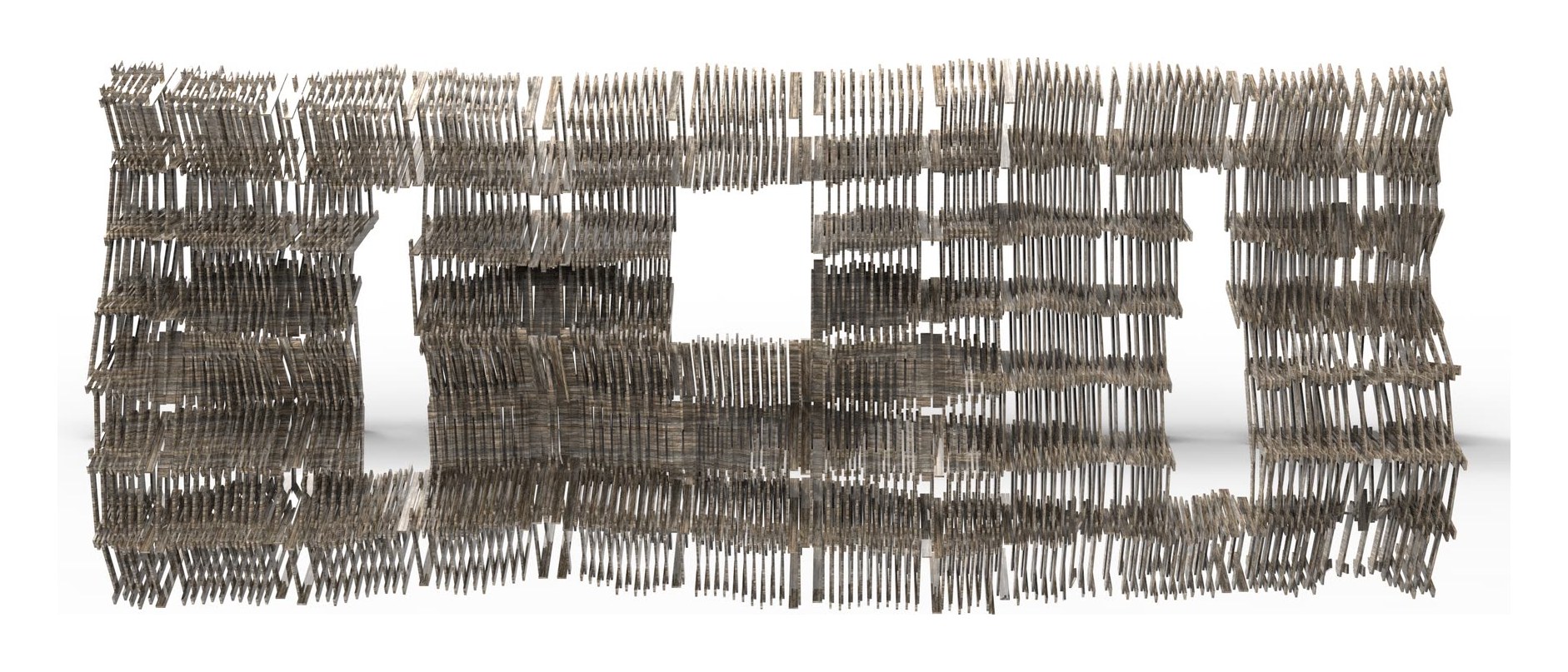
A methodology for building with reclaimed pallets — using computer vision, generative modelling and robotic fabrication to turn inconsistent waste into consistent structure.
Role
Individual thesis
Supervisor
Jeremy Ficca, Director, dFAB
Material
Reclaimed wood pallets
Stack
Python · OpenCV · Rhino / Grasshopper · RobotStudio · UDP
01 · The question
Salvage material is everywhere, yet it is rarely reused — because every piece differs in size, density and strength. Can a workflow absorb that uncertainty instead of rejecting it?
02 · The material
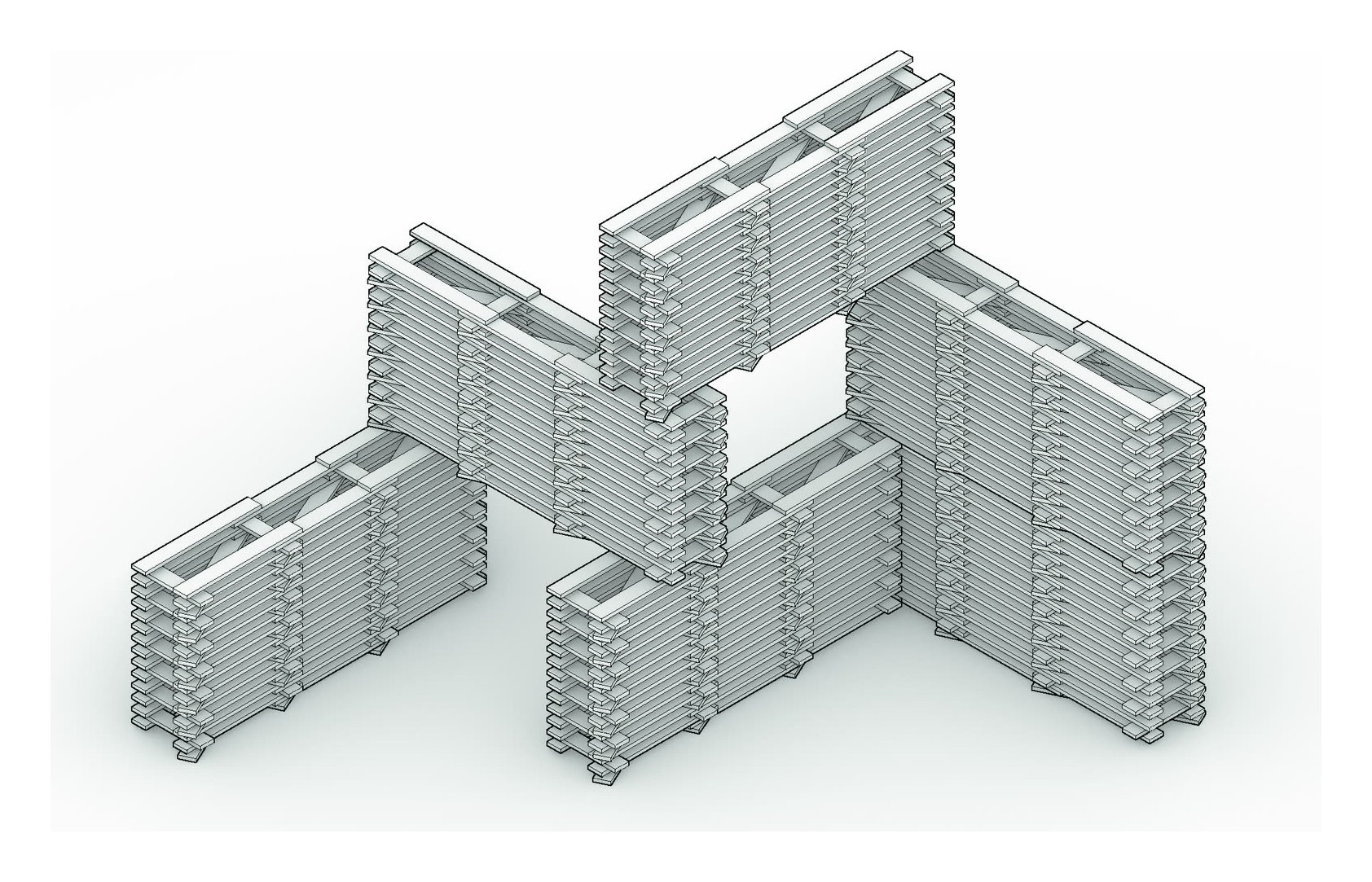
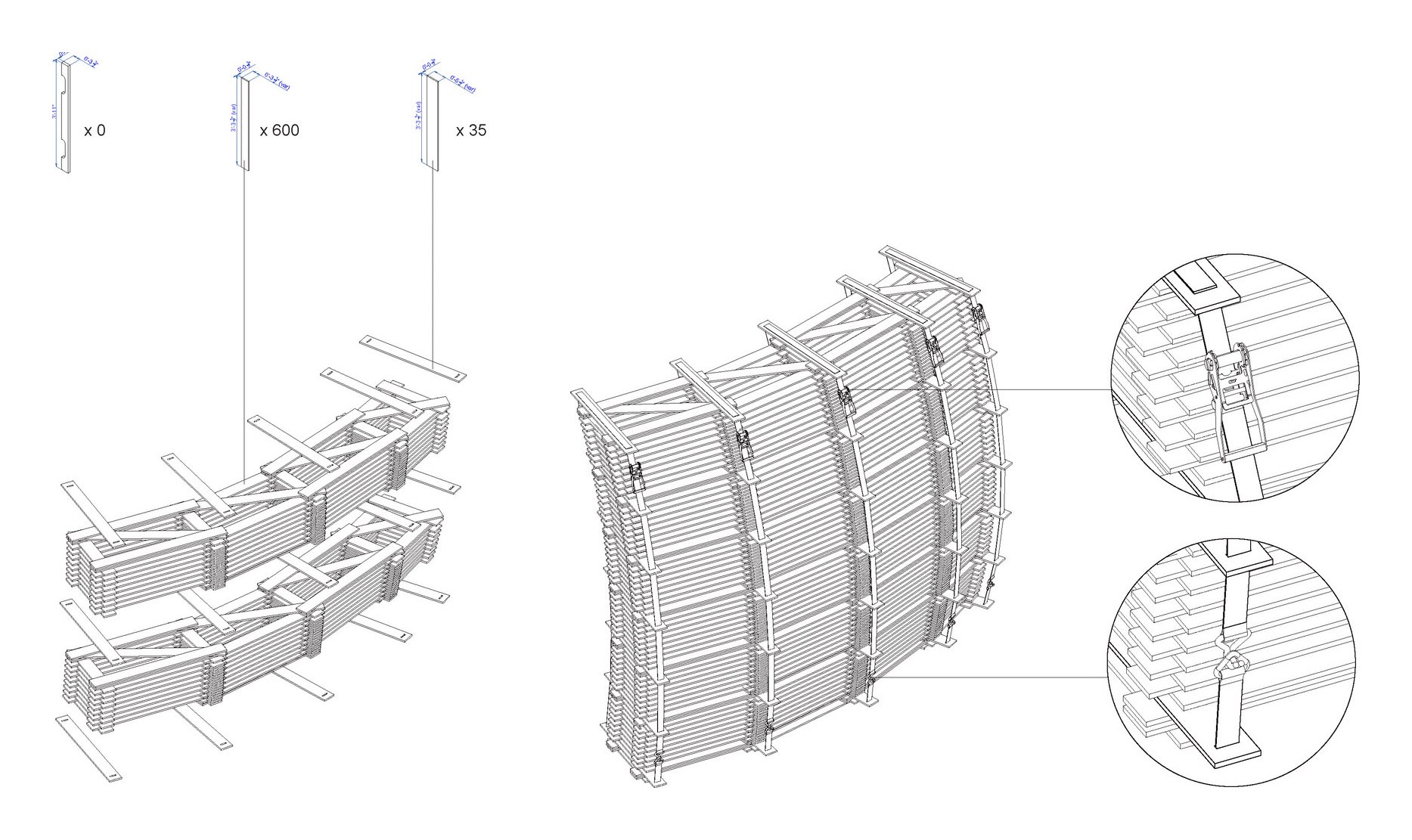
Wood pallets are strong, modular and almost entirely recyclable — but they arrive worn, nailed, split and inconsistent. The answer here is stacking: aggregating many imperfect boards so that the structure as a whole becomes uniform, even when the parts are not.
03 · Four modules, one kit of parts
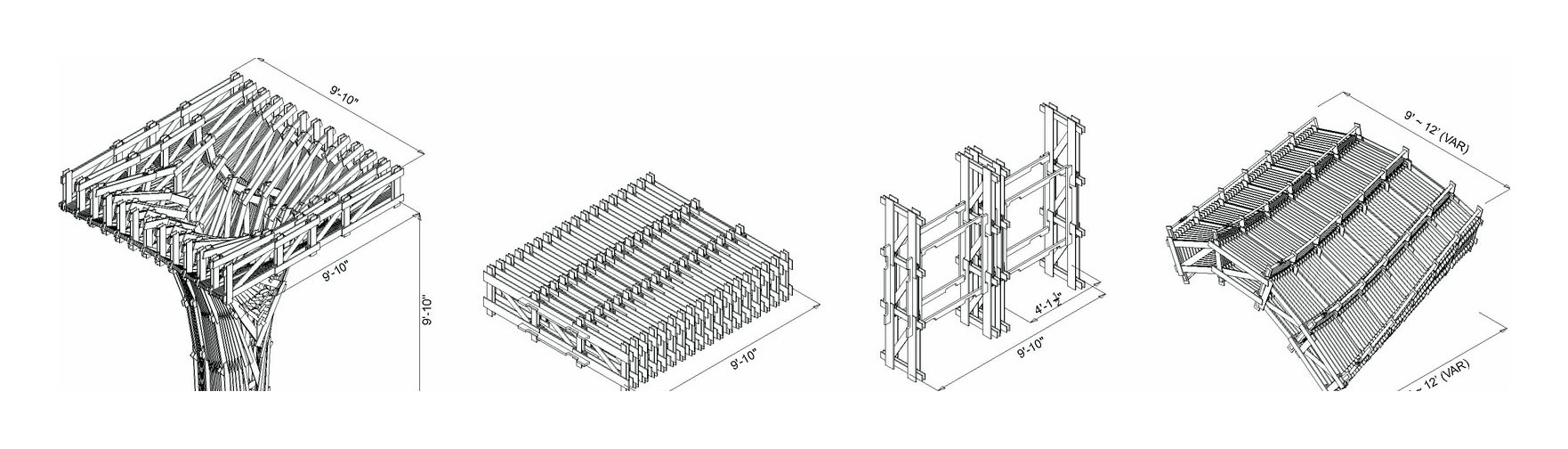
Pallet counts from the thesis
{{mod.role}}
{{mod.detail}}
Relative density
{{total}}
reclaimed pallets kept out of the waste stream
04 · The system
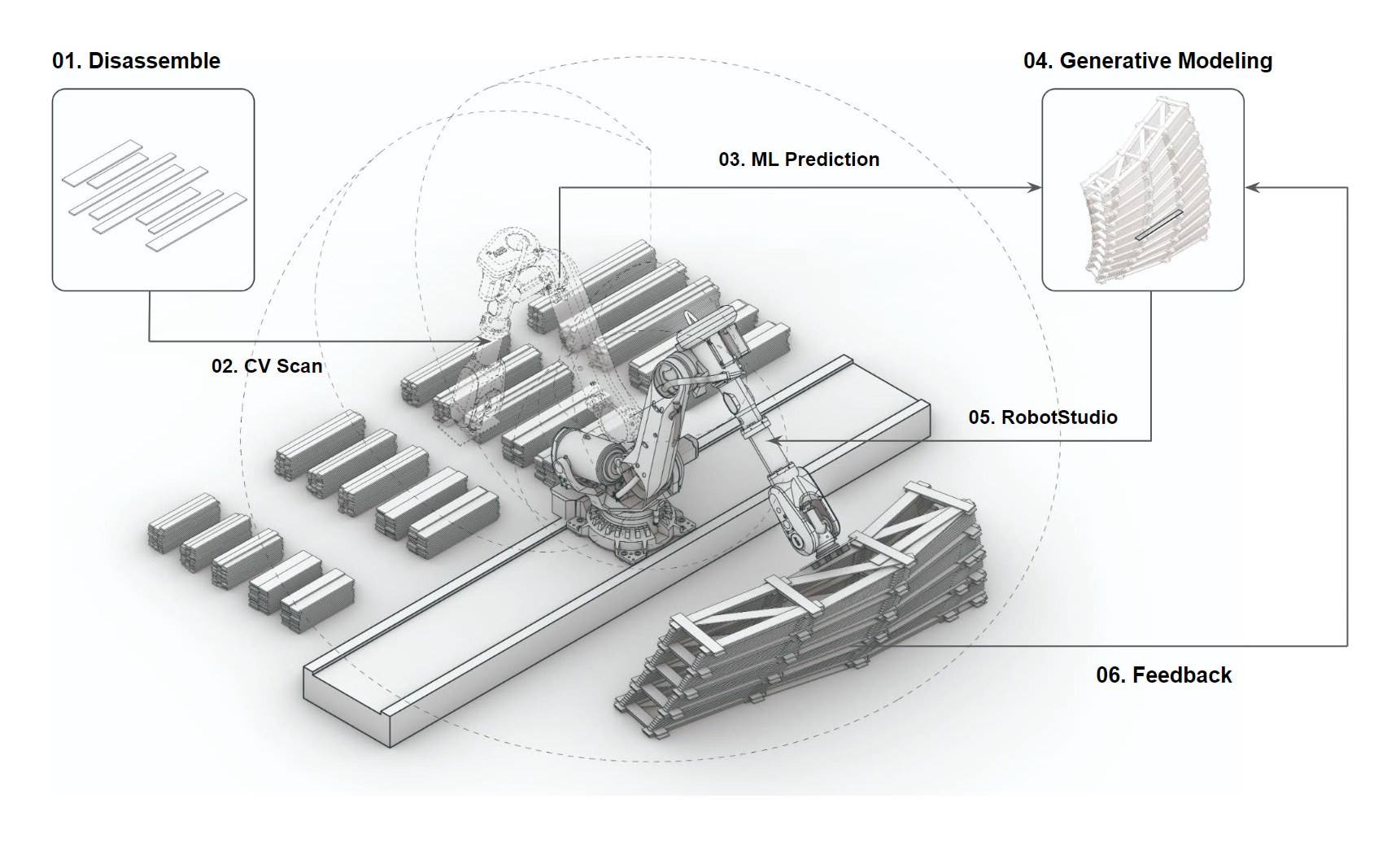
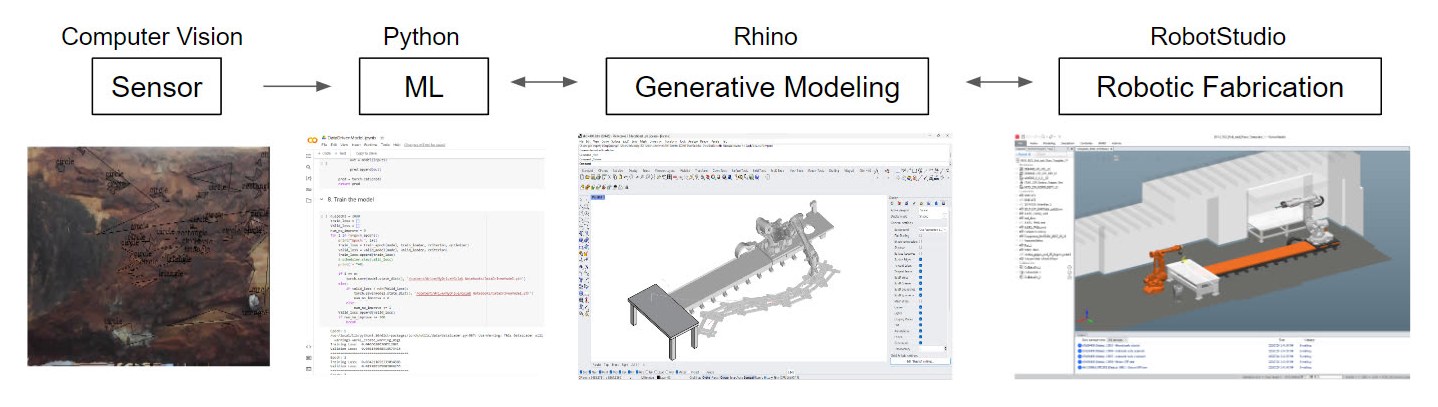
Four environments, one loop. Python sees, Grasshopper decides, RobotStudio builds — and UDP sockets keep them talking in real time.
# excerpt — OpenCV contour detection streamed to Grasshopper
gray     = cv2.cvtColor(frame, cv2.COLOR_BGR2GRAY)
thresh   = cv2.threshold(gray, 80, 300, cv2.THRESH_BINARY)[1]
contours = cv2.findContours(thresh, cv2.RETR_TREE,
                            cv2.CHAIN_APPROX_SIMPLE)[0]
for c in contours:
    approx = cv2.approxPolyDP(c, 0.03 * cv2.arcLength(c, True), True)
    ...                                   # classify board outline
UDP_client(IP, port, 'name:{}'.format(len(contours)))
A camera scans each board; its outline and condition are passed to the generative model, which assigns it to a module; the robot stacks it. A machine-learning layer for predicting board performance was prototyped as the next step. Switch to The Logic to see the code.
Demo · the loop running
A live session: the camera reads each board (right), the generative model places it in the wall and highlights it, and the robot simulation picks it up (left).
05 · The result
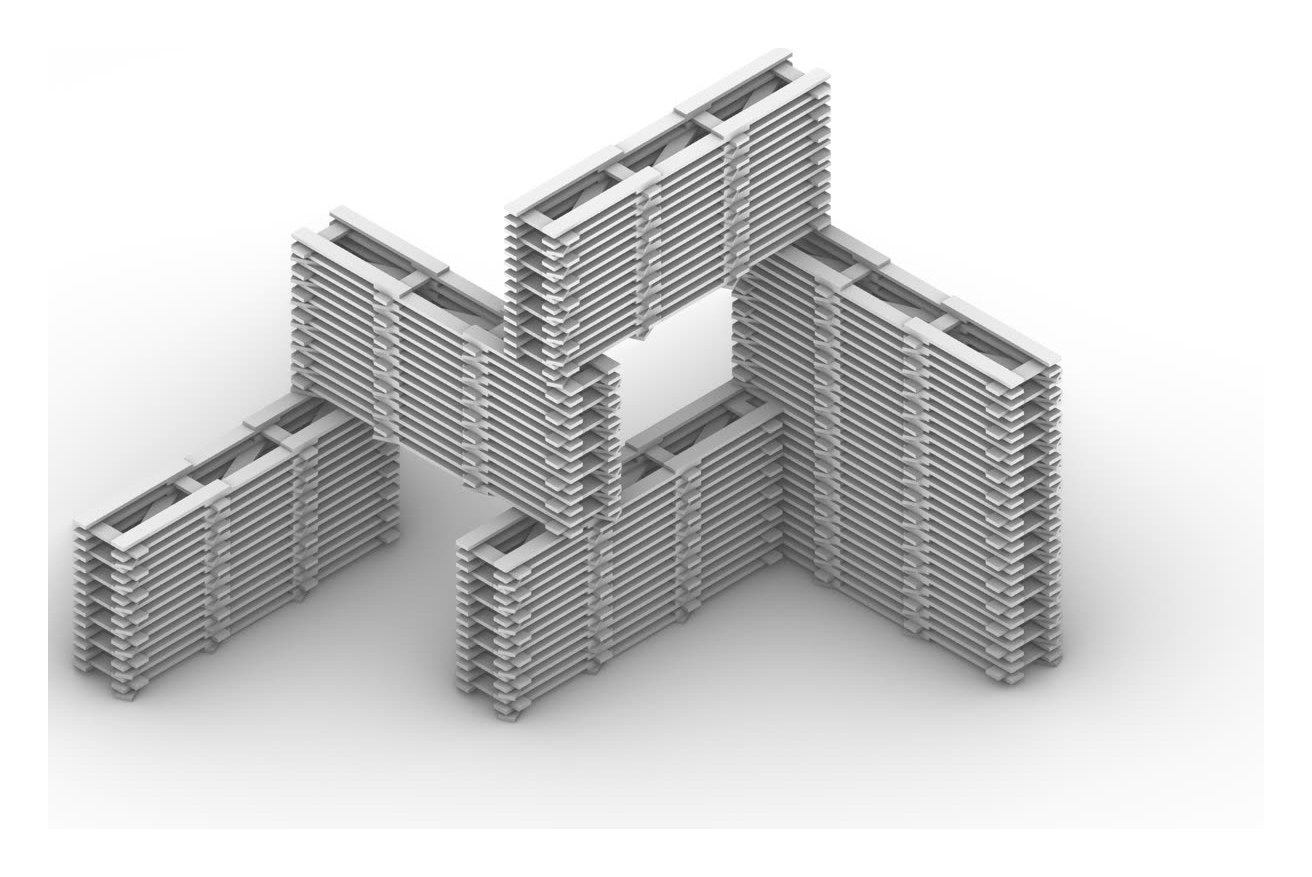
A circular, feedback-driven workflow showing that salvage material can be reused at architectural scale — from basic columns and walls to high-performance shell structures — with modules that can be taken apart and used again. Recognised with CMU’s Thesis / Capstone Project Award.
4
Module types
8–50
Pallets per module
10 ft
Standard grid
Back to the story
Art & sound →